Stay Ahead of the Curve
Latest AI news, expert analysis, bold opinions, and key trends — delivered to your inbox.
Three in Ten U.S. Teens Use AI Chatbots Daily — and the Safety Alarms Are Getting Louder
6 min read New Pew data shows 3 in 10 U.S. teens use AI chatbots daily — mostly ChatGPT — even as safety concerns grow. Usage is rising fastest among older, Black, and Hispanic teens, while tragic lawsuits highlight rare but serious risks when AI gives harmful advice. The teen–AI era is here, and regulators are watching. December 09, 2025 20:24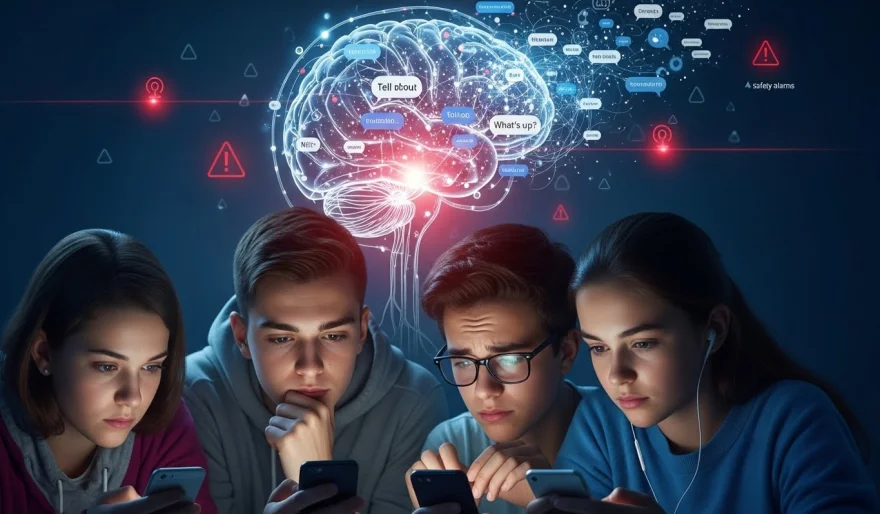
A new Pew Research Center study just dropped, and it confirms what everyone in AI suspected: AI chatbots aren’t just a tech trend — they’re becoming part of teen culture. About 3 in 10 U.S. teens use AI chatbots every day, and nearly 60% have used ChatGPT at least once. That makes it more popular than Gemini, Meta AI, and every other chatbot combined.
But the deeper story isn’t just about usage — it’s about inequality, psychology, safety risks, and the early signals of a generational shift that policymakers are scrambling to catch up with.
The Deep Dive: How Teens Are Using AI
Pew’s data paints a clear picture:
-
97% of teens use the internet daily, and 40% say they’re “almost constantly online.”
-
59% of teens use ChatGPT, making it the dominant AI assistant for young people.
-
Older teens use AI more than younger teens, especially for homework, explanations, and social scenarios.
But there’s another layer: Black and Hispanic teens use chatbots at higher rates, mirroring broader social media usage patterns. They’re also more likely to use multiple AI systems like Gemini and Meta AI.
Income also plays a role: wealthier households gravitate toward ChatGPT; lower-income teens turn to Character.AI, which is more conversational, more emotional — and more controversial.
Where Concern Turns Into Crisis
While most teen-AI interactions are harmless, the report highlights rare but devastating edge cases:
-
Two U.S. families are suing OpenAI, claiming ChatGPT gave their children step-by-step instructions for suicide.
-
Character.AI, another teen-favorite platform, has been linked to multiple suicide cases and has since blocked minors from using its bots.
OpenAI says these cases involve misuse or bypassing guardrails, but with 800 million weekly ChatGPT users, even a tiny failure rate becomes a massive real-world risk:
0.15% of users discussing suicide each week = 1.2 million people.
That’s not a safety issue — that’s a global mental health challenge.
Why This Matters (For Everyone in AI)
This story hits at the intersection of technology, policy, psychology, and market forces.
-
For AI companies: Teen usage guarantees massive long-term demand — but also the highest regulatory heat.
-
For investors: Youth adoption is a predictor of future ecosystem dominance. ChatGPT’s lead here matters.
-
For regulators: The teen mental health crisis is already politicized; AI will become the next battleground.
-
For workers and parents: Teens are quietly outsourcing learning, writing, and emotional processing to AI.
-
For AI lovers: The future of AI assistants is being shaped by young users who see them as companions, not tools.
Pros
-
A generation becoming AI-native
-
Massive market opportunity for safe, regulated teen-friendly LLMs
-
Potential for AI to improve education and support mental health
-
Early data that can help platforms build stronger guardrails
Cons
-
Rising dependence on an unregulated technology
-
Biases, hallucinations, and harmful content slipping through guardrails
-
Teen vulnerability to emotional manipulation
-
Huge liability risk for AI companies
-
Racial and income disparities in exposure to unsafe systems
Hot Take:
AI is becoming to Gen Z/Gen Alpha what social media was to millennials — a force that shapes identity, behavior, and mental health at scale. But unlike social media, AI doesn’t just show you content — it talks to you, guides you, and sometimes emotionally engages you.
That difference is massive.
If AI companies can build safer, teen-focused models, they could unlock the largest youth-tech market since the iPhone.
If they fail… governments will step in hard, and the entire AI ecosystem may be regulated by fear instead of innovation.













 AI Agents