Stay Ahead of the Curve
Latest AI news, expert analysis, bold opinions, and key trends — delivered to your inbox.
OpenAI Launches Improved Speech-to-Text Models for Real-World Audio
4 min read OpenAI has introduced two new speech-to-text models—GPT-Transcribe and GPT-Live-Transcribe—designed to deliver faster, more accurate transcription for both recorded and live audio. The models are built to handle noisy environments, diverse accents, and industry-specific terminology, making them far more reliable for real-world applications than previous generations. July 29, 2026 09:40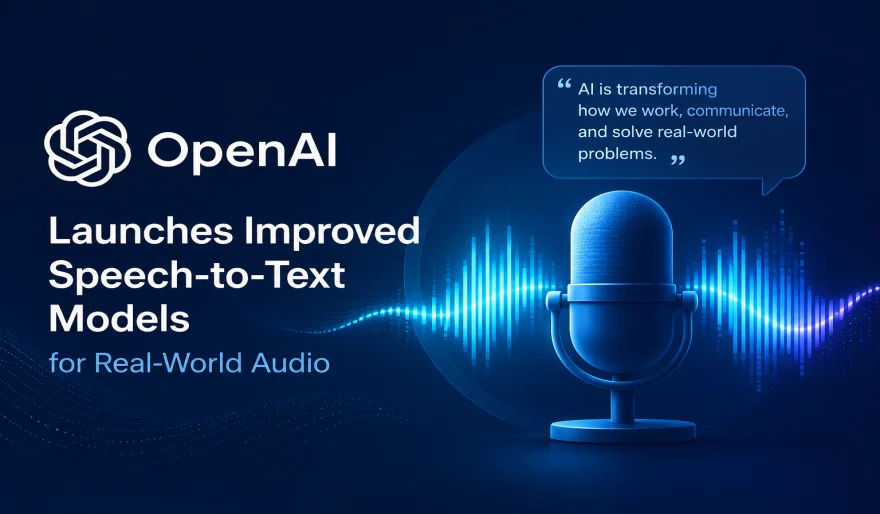
OpenAI is taking another major step in voice AI by launching GPT-Transcribe for recorded audio and GPT-Live-Transcribe for real-time conversations. Available through the API, the models are aimed at developers building everything from meeting assistants and customer support tools to voice agents and accessibility applications.
Unlike traditional speech recognition systems, the new models can use context—such as expected languages, company names, technical jargon, or custom keywords—to improve transcription accuracy. GPT-Live-Transcribe also remembers previous parts of a conversation, helping it better understand ongoing discussions instead of treating every sentence as an isolated event.
OpenAI says the models are significantly more resilient in difficult listening conditions, including crowded environments, background music, overlapping speech, and speakers with different accents. The company reports that the new transcription models reduce word error rates by more than half compared with Whisper in many scenarios, making them far more dependable for production use.
The launch expands OpenAI's growing voice ecosystem, following recent releases of more natural conversational voice models. Together, they move the company closer to AI systems that can listen, understand, and respond in real time with human-like fluency.
Why It Matters
Speech is rapidly becoming one of AI's most important interfaces. Better transcription means fewer errors in customer service, more reliable meeting summaries, stronger accessibility tools, and voice assistants that perform well outside quiet office environments. For businesses, it removes one of the biggest barriers to deploying AI-powered voice applications at scale.
The Upside
- Higher transcription accuracy in noisy, real-world environments.
- Better handling of accents, specialized vocabulary, and multilingual conversations.
- More capable voice assistants, AI agents, and accessibility tools.
The Downside
- Developers will need to integrate the new API models rather than relying solely on older systems like Whisper.
- As voice AI becomes more capable, concerns around privacy, consent, and voice data security will continue to grow.
Looking Ahead
OpenAI is clearly betting that voice will become a primary way people interact with AI. With transcription, reasoning, and conversational capabilities advancing together, we're moving toward AI assistants that can participate in meetings, answer calls, and understand spoken conversations as naturally as they process text.











 AI Agents