Stay Ahead of the Curve
Latest AI news, expert analysis, bold opinions, and key trends — delivered to your inbox.
OpenAI Launches GPT-5.6 Family Across ChatGPT, Codex, and API
3 min read OpenAI has officially rolled out its GPT-5.6 model family, introducing Sol, Terra, and Luna across ChatGPT, Codex, and its developer API. July 09, 2026 18:58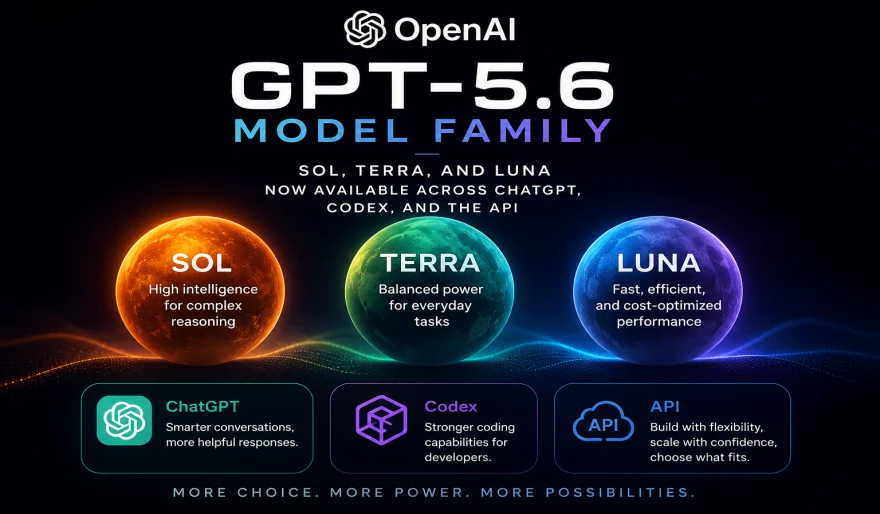
OpenAI's next generation of AI is here.
The company has officially released the GPT-5.6 family, bringing three new models—Sol, Terra, and Luna—to users across ChatGPT, Codex, and the OpenAI API. Rather than offering a one-size-fits-all model, OpenAI is giving users options tailored to different workloads, from advanced reasoning and coding to faster, more cost-efficient everyday tasks.
The rollout expands OpenAI's AI ecosystem for both consumers and developers. ChatGPT users gain access to more capable assistants, Codex users benefit from stronger coding performance, and developers can choose the model that best matches their application's speed, intelligence, and cost requirements.
The launch also signals OpenAI's strategy of creating a complete AI platform instead of relying on a single flagship model—giving businesses greater flexibility as AI adoption accelerates.
Why it matters
The AI race is no longer just about building the smartest model. It's about offering the right model for every task. With GPT-5.6, OpenAI is positioning itself to serve everyone from casual ChatGPT users to enterprise developers building AI-powered products.
The upside
- More specialized models for different workloads.
- Better coding capabilities through Codex.
- Greater flexibility and cost efficiency for developers.
- Stronger AI performance across ChatGPT and the API.
The downside
A growing lineup of AI models can also make choosing the right one more confusing. Developers and businesses may need time to understand which model best fits their needs.
Looking ahead
GPT-5.6 marks another shift toward purpose-built AI. As competitors continue releasing specialized models, the next phase of the AI race may be defined less by who has the biggest model—and more by who offers the best ecosystem.
User Comments (0)
Popular Apps
















 AI Agents