Stay Ahead of the Curve
Latest AI news, expert analysis, bold opinions, and key trends — delivered to your inbox.
OpenAI Launches ChatGPT Voice for Desktop App Control
4 min read OpenAI has expanded ChatGPT's voice capabilities, allowing users to control desktop applications using natural speech. The update moves ChatGPT beyond conversation, turning it into a hands-free AI assistant that can interact with software, navigate workflows, and complete tasks across a user's computer. July 24, 2026 14:14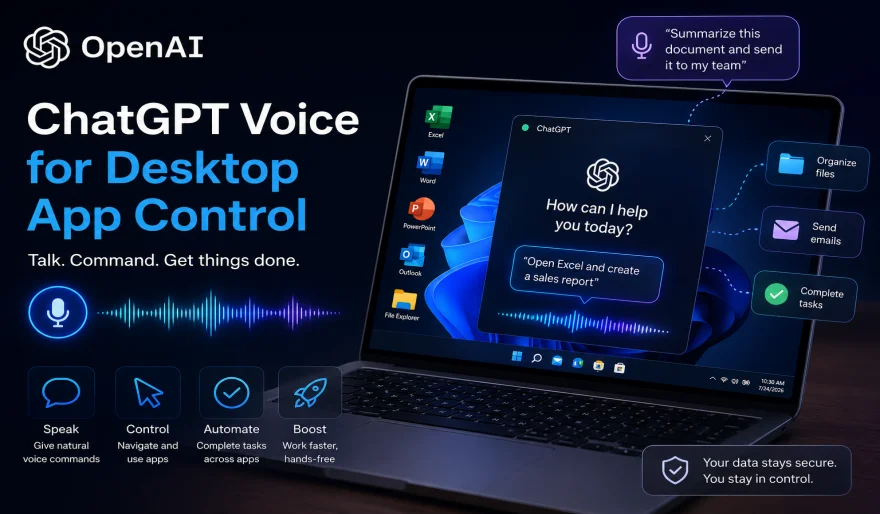
ChatGPT is taking another step toward becoming a true AI assistant.
OpenAI has introduced a new voice-powered feature that lets ChatGPT interact directly with desktop applications through spoken commands. Instead of simply answering questions, users can now ask ChatGPT to perform actions across supported apps, creating a more seamless and natural way to work.
With the new capability, users can launch applications, navigate interfaces, manage files, edit documents, and perform other computer tasks without relying entirely on a keyboard and mouse. The feature combines ChatGPT's advanced voice mode with desktop automation, allowing conversations to flow naturally while the AI carries out requested actions.
The update is part of OpenAI's broader vision of transforming ChatGPT into an AI agent that doesn't just provide information—it actively helps users complete work.
For professionals, creators, developers, and everyday users, this means routine tasks can increasingly be handled through simple voice instructions, making multitasking faster and more intuitive.
The launch also places OpenAI in more direct competition with assistants from Microsoft, Google, and Apple, all of which are racing to make AI a core part of the desktop computing experience.
Why it matters
The AI race is moving beyond chatbots.
Instead of simply generating text, AI assistants are evolving into software operators capable of interacting with applications, completing workflows, and acting on behalf of users. Voice-controlled desktop automation could become one of the biggest shifts in personal computing since the introduction of graphical user interfaces.
The upside
- Hands-free control can significantly boost productivity.
- Natural language commands reduce the need to memorize software shortcuts.
- AI assistants become more useful by completing tasks instead of only answering questions.
The downside
- Desktop control introduces new security and privacy considerations.
- Users will need confidence that AI actions are transparent and reversible.
- Wider access to computer controls raises the stakes if an AI makes mistakes or misunderstands commands.
Looking ahead
Voice is becoming the next major interface for AI. As assistants gain the ability to see screens, understand context, and control applications, interacting with computers may increasingly feel like collaborating with a human assistant rather than operating software manually. OpenAI's latest update is another step toward that future.
User Comments (0)
Popular Apps











 AI Agents