Stay Ahead of the Curve
Latest AI news, expert analysis, bold opinions, and key trends — delivered to your inbox.
Nvidia’s China comeback starts with the H200
6 min read Nvidia plans to ship its H200 AI chips to China by mid-February, pending government approval, marking the first advanced chip deliveries since U.S. export restrictions. The move signals a major policy shift, giving China short-term AI gains while keeping Nvidia’s supply controlled and geopolitics in play. December 22, 2025 14:59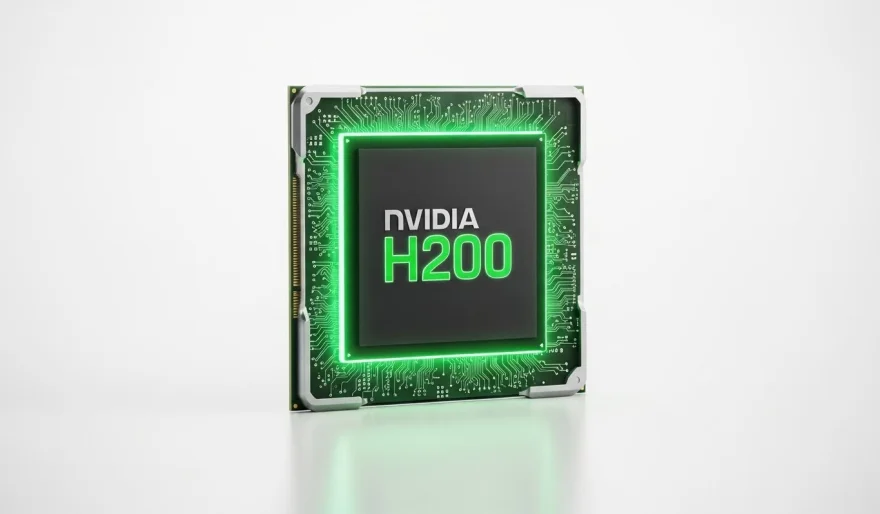
After more than a year of uncertainty, Nvidia is quietly preparing a return to the Chinese AI market — and it’s starting with the H200.
According to sources cited by Reuters, Nvidia has told Chinese clients it aims to begin shipping its H200 AI chips to China by mid-February, just ahead of the Lunar New Year. If approved, this would mark the first deliveries of advanced Nvidia AI chips to China since U.S. export restrictions were tightened under the Biden administration.
The initial batch is expected to come from existing inventory, with shipments totaling 5,000 to 10,000 chip modules, equivalent to roughly 40,000 to 80,000 H200 chips. That’s not a flood — but it’s enough to matter.
A policy reversal, with strings attached
This move follows a significant shift in U.S. policy. Earlier this month, President Donald Trump said Washington would allow H200 sales to China, but with a 25% fee attached. The administration has since launched an inter-agency review of license applications, signaling that the green light is real — but conditional.
Nothing is final yet. Beijing still needs to approve the purchases, and sources stress the entire plan hinges on government sign-off on both sides.
In short: this deal exists on paper, not yet on silicon.
Why the H200 still matters
The H200 isn’t Nvidia’s latest and greatest. It belongs to the Hopper generation, which has already been eclipsed by Nvidia’s newer Blackwell chips and its upcoming Rubin line.
But here’s the catch: the H200 is still extremely powerful, widely used in large-scale AI training and inference — and critically, Chinese chipmakers haven’t yet matched its performance.
That’s what makes this moment so delicate.
Allowing H200 imports could give Chinese AI companies a near-term boost, but it may also slow the momentum of China’s domestic chip industry, which Beijing has been aggressively trying to accelerate.
Nvidia’s balancing act
From Nvidia’s perspective, this is classic tightrope walking.
The company has largely shifted production capacity toward Blackwell, making H200 supply relatively scarce. Releasing limited volumes to China lets Nvidia:
-
Monetize older-generation inventory
-
Re-enter a massive AI market without fully reopening the floodgates
-
Stay aligned with U.S. policy constraints
It’s a controlled release, not a full reset.
Nvidia has also told Chinese clients it plans to add new production capacity for the H200, with orders opening in Q2 2026 — another signal that the company sees ongoing, but carefully managed, demand.
Why this matters
This isn’t just about chips. It’s about AI geopolitics entering a new phase.
Under Biden, the strategy was blunt: block advanced AI hardware to China. Under Trump, the approach is more transactional — allow access, but tax it, monitor it, and control the volume.
For Nvidia, this could reopen billions in revenue.
For China, it offers short-term relief — but risks long-term dependence.
For the global AI race, it signals that decoupling is giving way to conditional re-coupling.
The bigger picture
This move doesn’t end the chip war. It reframes it.
Instead of outright bans, we’re entering an era of licensed access, strategic throttling, and political oversight baked directly into silicon supply chains.
Nvidia isn’t just shipping chips again.
It’s shipping them under a new rulebook — one where AI hardware is no longer just technology, but leverage.



















 AI Agents