Stay Ahead of the Curve
Latest AI news, expert analysis, bold opinions, and key trends — delivered to your inbox.
Musk wants SpaceX IPO to fund AI space data centers
5 min read Elon Musk may take SpaceX public to fund massive AI data center expansion on Earth, as demand for compute surges. Meanwhile, Microsoft’s failed underwater data center experiment highlights how complex and costly alternative infrastructure can be. April 01, 2026 19:42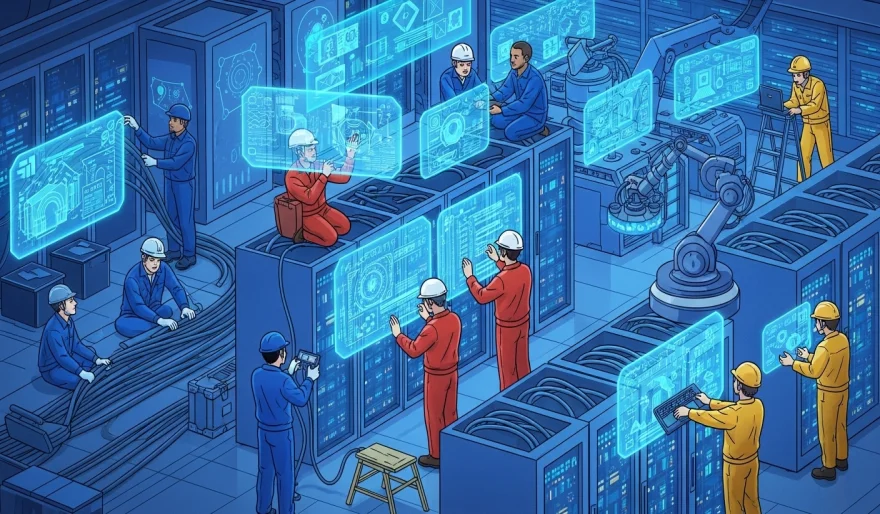
Elon Musk is reportedly exploring a future IPO for SpaceX—not just as a liquidity event, but as fuel for something much bigger: AI-powered space data centers.
Yes, the ambition is exactly what it sounds like.
Instead of building ever-larger server farms on Earth, Musk is eyeing orbit as the next frontier for compute—where solar energy is abundant, cooling is easier, and data infrastructure could operate beyond terrestrial limits.
But there’s a catch. And it’s already cost billions.
The Vision: AI Infrastructure… in Space
The idea is simple in theory, radical in execution:
- Launch AI data centers into orbit
- Power them with continuous solar energy
- Use space’s natural vacuum for cooling efficiency
- Potentially connect them to Earth via satellite networks like Starlink
For Musk, this aligns perfectly with SpaceX’s long-term mission: make space economically useful, not just exploratory.
And with AI compute demand exploding, whoever controls infrastructure wins.
The Reality Check: Microsoft’s Underwater Failure
Before space, Big Tech tried something closer to home.
Microsoft experimented with underwater data centers through its Project Natick, placing servers on the ocean floor to solve cooling and energy challenges.
It worked—technically.
But commercially? Not so much.
The project was eventually shelved due to:
- High deployment and maintenance costs
- Limited scalability
- Operational complexity in extreme environments
In short: just because you can build data centers in extreme environments doesn’t mean you should.
Why This Matters
This moment reveals a deeper shift:
AI is no longer just about models—it’s about infrastructure supremacy.
- Cloud giants are hitting energy and land constraints
- AI training costs are skyrocketing
- Governments are beginning to view compute as strategic national infrastructure
So companies are asking a wild but logical question:
If Earth is becoming inefficient… why not go beyond it?
The Risk Nobody Is Talking About
Space data centers sound futuristic—but they come with massive unknowns:
- Launch costs still remain high, even with SpaceX efficiencies
- Hardware maintenance in orbit is nearly impossible
- Latency challenges could affect real-time AI applications
- Space debris and geopolitical risks add new layers of complexity
And Microsoft’s failed ocean experiment is a clear signal:
Extreme environments don’t forgive mistakes—and they rarely scale cheaply.
The Bigger Picture
Musk isn’t just thinking about an IPO.
He’s positioning SpaceX as the backbone of a new AI infrastructure layer—one that isn’t limited by Earth itself.
If it works, it could redefine:
- Cloud computing
- Energy economics
- And who really controls the future of AI
If it fails?
It’ll be another reminder that physics, not ambition, sets the ceiling.



















 AI Agents