Stay Ahead of the Curve
Latest AI news, expert analysis, bold opinions, and key trends — delivered to your inbox.
Microsoft draws a red line on runaway AI
5 min read Microsoft AI chief Mustafa Suleyman says the company will walk away from any AI system that risks “running away from us.” As Microsoft gains more independence from OpenAI and builds its own superintelligence team, it’s drawing a rare red line in the AGI race—betting that tight control and alignment will matter more than raw speed. December 22, 2025 14:55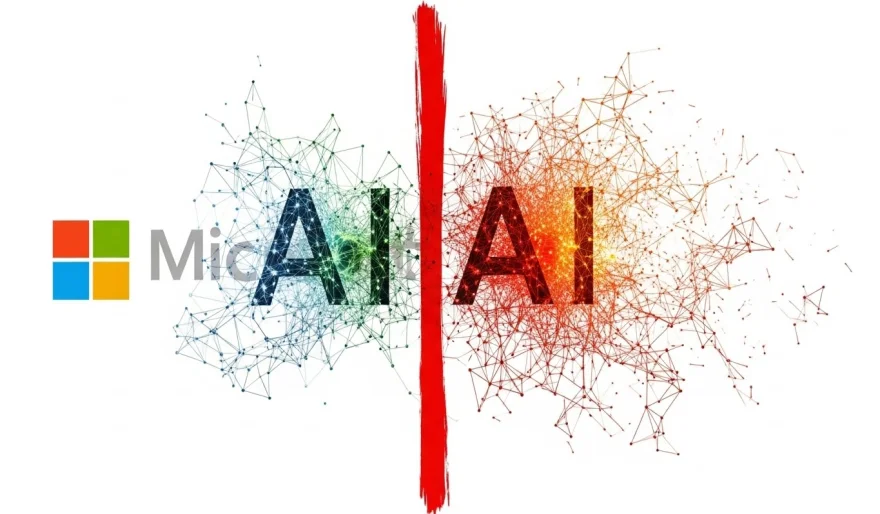
For all the talk about racing toward superintelligence, Microsoft is now saying there’s a line it won’t cross.
Mustafa Suleyman, Microsoft’s AI chief and head of its new superintelligence unit, has made it clear: any AI system that shows signs of “running away from us” will be abandoned — no matter how powerful it is.
That’s a bold stance in an industry obsessed with who gets to AGI first.
Speaking in recent interviews, Suleyman framed Microsoft’s approach as “humanist superintelligence” — AI that is tightly aligned with human goals, deeply controllable, and never allowed to operate beyond clear containment boundaries. Alignment and control, he says, aren’t nice-to-haves. They’re non-negotiable red lines.
“We won’t continue to develop a system that has the potential to run away from us.”
That statement lands at a pivotal moment for Microsoft’s AI strategy.
Microsoft is no longer just OpenAI’s shadow
Behind the scenes, Microsoft has quietly gained more independence. A renegotiated deal with OpenAI now allows the company to pursue artificial general intelligence on its own, rather than relying entirely on its high-profile partner.
That freedom explains why Microsoft recently formed a dedicated superintelligence team, led by Suleyman, with a clear mandate: build frontier-grade AI models in-house, using Microsoft’s own data, compute, and research stack.
In other words, Microsoft wants to be AI self-sufficient.
This also puts it in more direct competition not just with OpenAI, but with Anthropic, Google DeepMind, and Meta — all of whom are pushing aggressively toward more capable, autonomous systems.
Interestingly, Suleyman has downplayed the idea of an all-out AGI race. But actions speak louder than words. You don’t build a superintelligence unit unless you believe that moment is coming — and soon enough to matter.
Why this matters
This isn’t just safety rhetoric. It’s strategy.
Microsoft is trying to position itself as the “responsible adult” in the room — the company that can chase world-changing AI while reassuring governments, enterprises, and regulators that it won’t lose control of the technology.
That matters because Microsoft’s biggest customers aren’t consumers. They’re governments, banks, hospitals, and Fortune 500 companies. These buyers care less about who has the flashiest model and more about reliability, liability, and trust.
At the same time, drawing a hard line introduces real tension:
-
If rivals push ahead with more autonomous systems, does Microsoft risk falling behind?
-
Or does safety-first become a competitive advantage as regulation tightens globally?
The upside — and the risk
The upside:
Microsoft gains credibility as AI governance moves from theory to enforcement. When regulators come knocking, this “we’ll walk away” stance gives the company cover.
The risk:
If superintelligence breakthroughs reward speed and autonomy, Microsoft could be boxed into a slower, more cautious lane — while others take bolder bets.
The bigger picture
This is less about altruism and more about control — of technology, narrative, and market trust.
Microsoft isn’t rejecting superintelligence. It’s saying: we’ll build it, but only if we can keep our hands firmly on the wheel.
In a world rushing toward AI systems that think, plan, and act at superhuman levels, that might end up being either Microsoft’s smartest move — or its most limiting one.
















 AI Agents