Stay Ahead of the Curve
Latest AI news, expert analysis, bold opinions, and key trends — delivered to your inbox.
Google Just Dropped an AI App That Works Without the Internet
4 min read Google quietly launched AI Edge Eloquent, an offline-first dictation app that runs entirely on-device, turning speech into polished text without internet. The move signals a major shift toward edge AI, where speed, privacy, and accessibility matter as much as raw model power—hinting that the future of AI may live less in the cloud and more in your pocket. April 07, 2026 12:20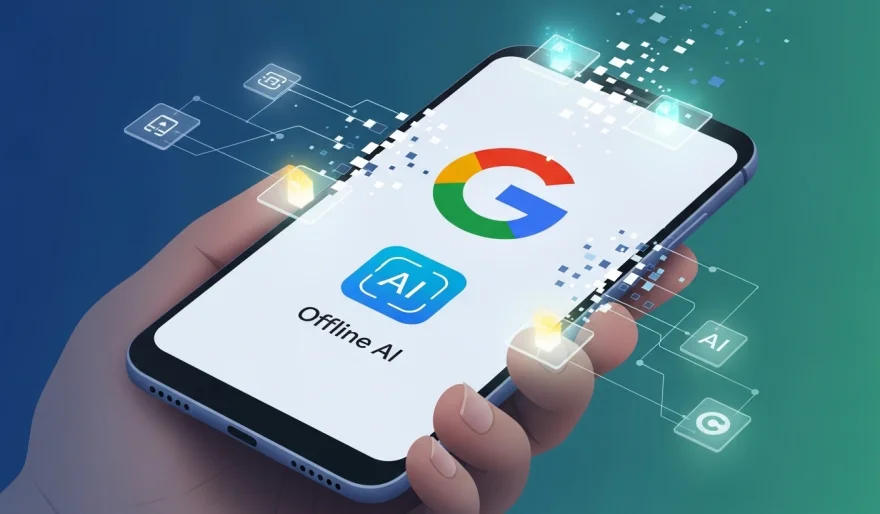
In the middle of the cloud AI race, Google just made a quiet but strategic move: it launched a fully offline AI dictation app—and didn’t even announce it.
The app, called Google AI Edge Eloquent, runs entirely on-device, turning speech into polished text without needing an internet connection.
What’s really happening
This isn’t just another voice-to-text tool—it’s a shift toward “edge AI”.
Instead of sending your voice to the cloud:
- Speech is processed locally on your phone using lightweight AI models
- Text is generated in real time and cleaned up automatically
- Filler words like “um” and “ah” are removed instantly
It’s fast, private, and—most importantly—works anywhere, even with zero connectivity.
Why this matters
For years, AI has been tied to the cloud:
- You speak → data gets uploaded → AI responds
Google is flipping that model:
👉 AI runs on your device, not on their servers
That changes three things instantly:
- Speed: no latency from cloud processing
- Privacy: your voice data never leaves your phone
- Accessibility: usable in low-connectivity regions
This is especially relevant in markets where internet isn’t always reliable—suddenly, AI becomes always-on infrastructure, not a luxury.
The bigger play
Google isn’t just launching an app—it’s testing a future where:
- AI assistants live on-device by default
- Cloud becomes optional, not required
- Phones become self-contained AI systems
The app even hints at hybrid workflows, where offline output can later be refined using Gemini in the cloud if needed.
The subtle risk
Edge AI sounds perfect—but there are tradeoffs:
- On-device models are still less powerful than cloud systems
- Performance depends heavily on your hardware
- Developers now have to optimize for fragmented devices, not centralized compute
The bigger trend (hot take)
We’re watching AI split into two layers:
👉 Cloud AI = power
👉 Edge AI = presence
And the companies that win won’t just build smarter models—they’ll decide where AI actually lives.














 AI Agents