Stay Ahead of the Curve
Latest AI news, expert analysis, bold opinions, and key trends — delivered to your inbox.
Epstein Scrutiny Forces Bill Gates to Skip India AI Summit
6 min read Bill Gates withdrew from India’s major AI summit after renewed public scrutiny over his past association with Jeffrey Epstein resurfaced. His team said the decision was made to keep the focus on the event rather than the controversy. February 19, 2026 14:41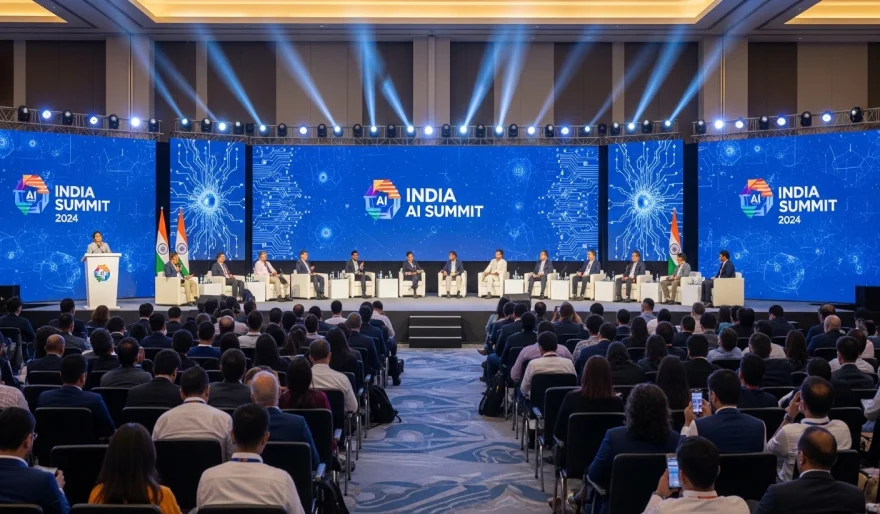
India’s big AI summit was meant to be a signal.
Signal to the Global South.
Signal to investors.
Signal that AI power isn’t just Silicon Valley anymore.
And at the center of that signal? Bill Gates.
Then he pulled out.
The decision came amid renewed public scrutiny around his past association with Jeffrey Epstein — an issue Gates has previously called a “mistake” while denying wrongdoing. With fresh attention circulating online and in media circles, his team confirmed he would no longer appear, reportedly to keep the focus on the summit itself.
But here’s the real story: this isn’t just about one speaking slot.
It’s about how fragile AI optics have become.
AI Is Now Political Capital
India has been aggressively positioning itself as a serious AI power — not just a talent hub, but a governance voice. The summit was part of a broader strategy: attract global partnerships, accelerate domestic AI infrastructure, and shape the narrative around responsible AI for emerging economies.
Having Bill Gates there wasn’t random.
He represents:
-
Legacy tech credibility
-
Global health and development influence
-
A bridge between philanthropy and frontier technology
When someone like that steps off the stage, it shifts the emotional temperature of the room.
Even if the event continues.
Even if the funding pledges still roll in.
Because AI leadership today is less about who builds the best model — and more about who the world trusts to shape its future.
The Optics Economy Is Ruthless
We’re in a new era where reputational risk moves faster than official statements.
In the past, a controversy tied to an executive’s personal history might have stayed compartmentalized. In 2026? It bleeds into everything:
-
AI governance conversations
-
Public funding debates
-
Regulatory negotiations
-
Cross-border tech diplomacy
When AI is positioned as critical infrastructure — like energy or telecom — the people associated with it become symbolic institutions.
And symbols get scrutinized.
This isn’t unique to Gates. We’ve seen similar pressures across the industry. As AI systems get embedded into healthcare, defense, finance, and education, the bar for moral credibility rises. Not just legal compliance — moral legitimacy.
That’s a different game.
Why This Hits Differently in 2026
There’s something else happening beneath the surface.
Public trust in tech is already fragile.
We’ve had:
-
Deepfake elections
-
AI copyright battles
-
Bias controversies
-
Job displacement anxiety
-
Ad-driven chatbot debates
So when any ethical shadow appears near a high-profile AI gathering, it doesn’t land in a vacuum. It lands in a tense ecosystem.
India’s AI summit was designed to project stability and leadership. Instead, part of the conversation drifted toward legacy associations and accountability.
Fair or unfair — that’s the cost of operating at AI’s highest levels now.
The Bigger Pattern
Zoom out.
The AI race is no longer just model vs. model.
It’s narrative vs. narrative.
Countries are competing on:
-
Safety frameworks
-
Public trust
-
Talent pipelines
-
Ethical positioning
-
Strategic alliances
In that context, even a keynote cancellation becomes geopolitical subtext.
Hot take: As AI becomes national infrastructure, its ambassadors will be judged like heads of state — not startup founders.
Clean optics won’t be optional. They’ll be strategic assets.
And here’s the uncomfortable truth:
The more powerful AI becomes, the less forgiving the public will be about the people steering it.
Not because they’re perfect.
But because the stakes are no longer abstract.
In 2026, intelligence is automated.
Credibility isn’t.



















 AI Agents