Stay Ahead of the Curve
Latest AI news, expert analysis, bold opinions, and key trends — delivered to your inbox.
Chinese Military Researchers Use U.S. AI Models to Advance Defense Systems
4 min read A Reuters investigation has found that Chinese military-linked researchers have been using outputs from leading U.S. AI models, including those from OpenAI and Anthropic, to train domestic AI systems for defense applications. The findings add a new dimension to the growing AI rivalry between Washington and Beijing. July 31, 2026 13:47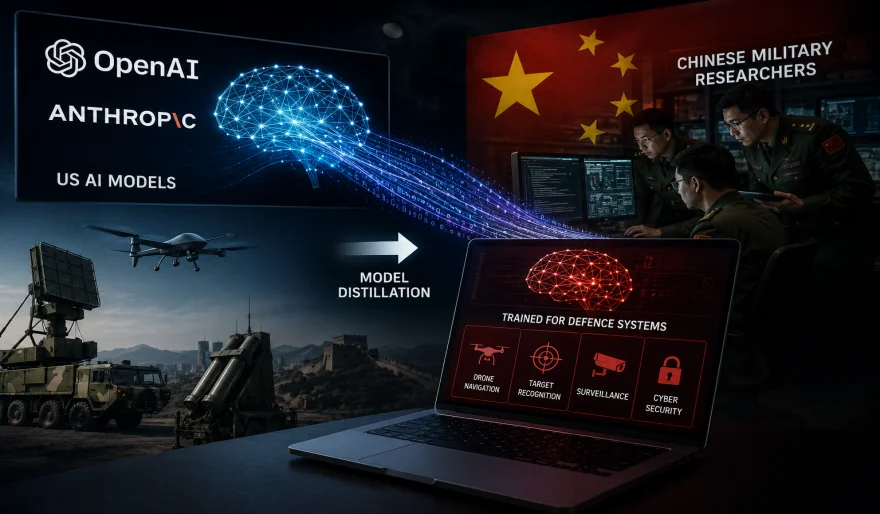
Despite U.S. export controls designed to limit China's access to advanced AI technologies, researchers affiliated with China's military have reportedly found another route: AI model distillation.
According to a Reuters review of more than 80 Chinese academic papers and patents, researchers connected to the People's Liberation Army (PLA) have used outputs generated by advanced U.S. AI models to train smaller, specialized Chinese models. Instead of copying the original systems, they used a technique known as model distillation, where a powerful AI acts as a "teacher" for a more efficient local model.
The resulting systems are designed to operate independently inside secure Chinese networks and require far less computing power than frontier AI models. Researchers described applications ranging from drone navigation and battlefield decision support to cybersecurity, surveillance, and target recognition. In one example, a PLA-linked team reportedly used GPT-3.5 outputs to analyze source code before transferring the learned capabilities into a locally deployed model.
The report comes amid escalating tensions over AI capability extraction. U.S. officials have accused some Chinese organizations of using proprietary AI systems to accelerate domestic development without authorization, while China rejects the allegations, arguing that Washington is using AI restrictions to maintain technological dominance.
Why It Matters
The AI race is no longer just about building the biggest models—it's about who can most effectively adapt and deploy them. If model distillation can bypass some of the barriers created by chip export controls, governments may need to rethink how AI technologies are protected.
The Upside
- Shows how AI innovation can spread through efficient training techniques.
- Smaller models reduce computing costs while retaining useful capabilities.
- Demonstrates the growing strategic importance of AI expertise over raw computing power.
The Downside
- Raises national security concerns over military applications of frontier AI.
- Could trigger stricter controls on AI APIs and model access.
- Intensifies the technology rivalry between the U.S. and China, with broader geopolitical implications.
Bottom Line:
The latest findings suggest that restricting AI chips alone may not be enough to slow military AI development. As model distillation becomes more powerful, the next battleground in the AI race could shift from hardware to access, intellectual property, and the control of advanced AI capabilities.


















 AI Agents