Stay Ahead of the Curve
Latest AI news, expert analysis, bold opinions, and key trends — delivered to your inbox.
Canva Is Building an AI Marketing Machine
4 min read Canva is expanding beyond design, acquiring Simtheory and Ortto to deepen its push into AI-powered marketing and automation. The move signals a bigger ambition: turning Canva into an end-to-end growth platform, not just a creative tool. April 09, 2026 12:50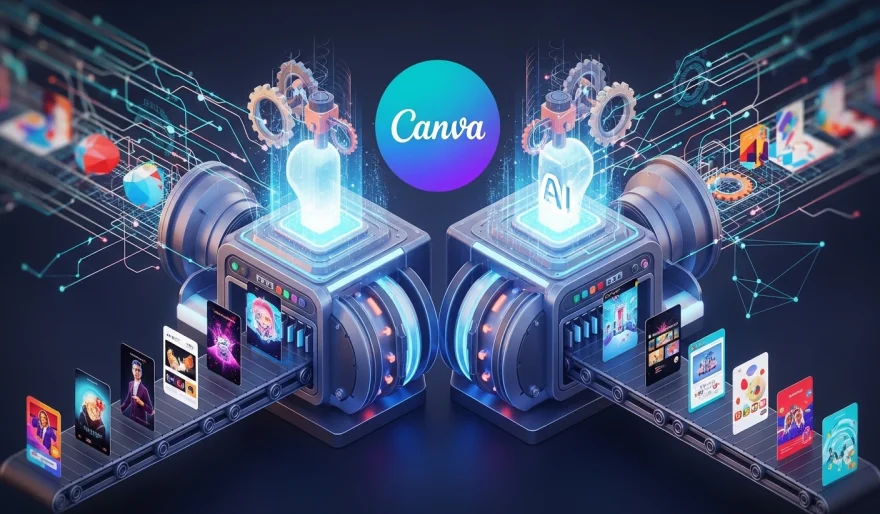
For years, Canva has owned the “anyone can design” narrative.
Simple templates. Drag-and-drop. Fast content creation.
But creation is only half the game.
Distribution—and more importantly, performance—is where the real value sits.
And Canva knows it.
With these acquisitions, Canva is stepping into a much bigger arena: marketing automation powered by AI.
Simtheory brings intelligence.
Ortto brings orchestration.
Together, they unlock something powerful: the ability to not just create content, but to test it, deploy it, optimize it, and scale it automatically.
Think about what that looks like in practice:
A user designs an ad in Canva…
AI suggests variations based on audience behavior…
The system auto-deploys across channels…
And continuously optimizes based on performance data.
No switching tools. No fragmented workflows.
Just one loop: create → launch → learn → iterate.
That’s a direct shot at platforms like HubSpot and Mailchimp—and even parts of Adobe’s ecosystem.
Because Canva’s advantage isn’t just features.
It’s distribution.
Hundreds of millions of users are already inside the product, creating content daily. If Canva can layer automation and AI-driven insights on top of that behavior, it doesn’t need to “win” new users—it just needs to expand what existing users can do.
But there’s a deeper shift happening here.
We’re moving from tools that help you create…
To systems that help you decide what to create—and why.
That’s where AI changes the game.
Instead of guessing which design or message will work, the platform can start predicting outcomes before you even hit publish.
And over time, that turns creativity into something closer to a performance engine.
Still, there are risks.
Marketing automation is crowded—and complex. Integrating these systems seamlessly into Canva’s simple, user-friendly experience won’t be easy.
There’s also the question of depth vs simplicity. Canva wins because it’s easy. But serious marketers expect granular control. Balancing both could be tricky.
Why it matters:
Canva isn’t just competing in design anymore—it’s moving up the value chain into revenue generation. If it succeeds, it could become the default platform not just for creating content, but for growing businesses.
Forward look:
The next generation of creative tools won’t stop at design. They’ll own the entire lifecycle—from idea to impact. Canva is positioning itself early for that shift—and quietly turning into a full-stack AI marketing platform.















 AI Agents