Stay Ahead of the Curve
Latest AI news, expert analysis, bold opinions, and key trends — delivered to your inbox.
Anthropic Builds In-House AI Chip Team to Power Claude
3 min read Anthropic is forming its own AI chip design team to develop custom hardware for Claude, reducing its reliance on third-party chipmakers and strengthening control over the infrastructure powering its next generation of AI models. August 05, 2026 15:20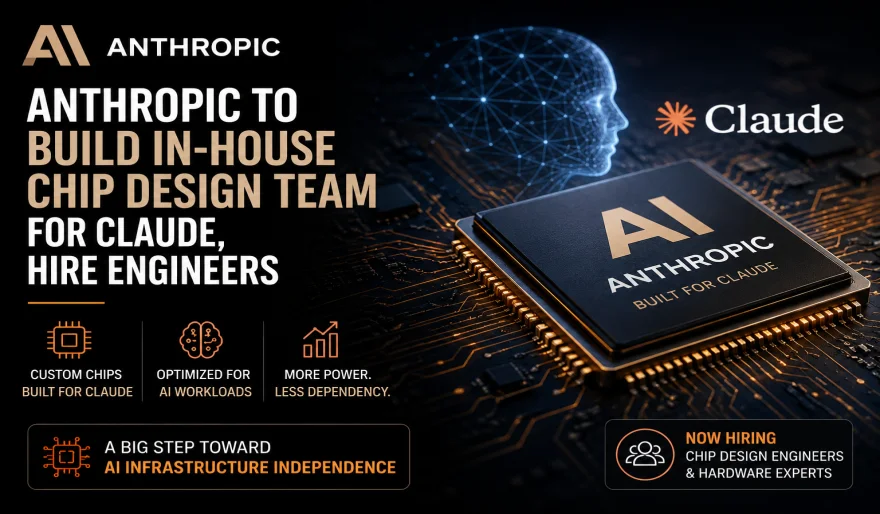
Anthropic is making a move that could reshape its AI strategy for years to come.
The company behind Claude is building an in-house chip design team and actively hiring engineers with expertise in semiconductor architecture, silicon design, and hardware optimization. The goal is to create custom AI chips tailored specifically for training and running Claude models more efficiently.
Today, companies like Anthropic depend heavily on GPUs from Nvidia and other hardware providers. Designing custom chips could help the company lower infrastructure costs, improve performance, and optimize its models for specific AI workloads as demand for compute continues to surge.
The move follows a growing trend across the AI industry. Tech giants including Google, Amazon, Microsoft, and Meta have all invested in custom AI silicon to reduce dependence on external suppliers while improving efficiency at scale. Anthropic now appears to be taking a similar path.
Why it matters
AI leadership is no longer determined by software alone. Companies that control both their models and the hardware running them could gain a significant competitive advantage in performance, cost, and scalability.
The upside
- Optimized chips for Claude's AI workloads.
- Reduced dependence on third-party GPU suppliers.
- Lower long-term infrastructure costs.
- Greater control over AI performance and scalability.
The downside
Building custom chips is expensive, time-consuming, and highly competitive. Anthropic will still need to prove its silicon can compete with established AI hardware from Nvidia and other industry leaders.
Looking ahead
The AI race is rapidly becoming a hardware race. As more AI companies develop their own chips, the future of artificial intelligence will depend not only on who builds the smartest models—but also on who builds the fastest and most efficient hardware to power them.



















 AI Agents