Stay Ahead of the Curve
Latest AI news, expert analysis, bold opinions, and key trends — delivered to your inbox.
AI is tracking Santa again — and it’s way smarter than you remember
6 min read AI is helping track Santa this Christmas Eve, with NORAD and Google using 3D maps, voice assistants, and generative AI for games, stories, and live updates. What started as a simple tracker is now a family-friendly demo of how AI can power creativity, learning, and holiday magic. December 24, 2025 17:50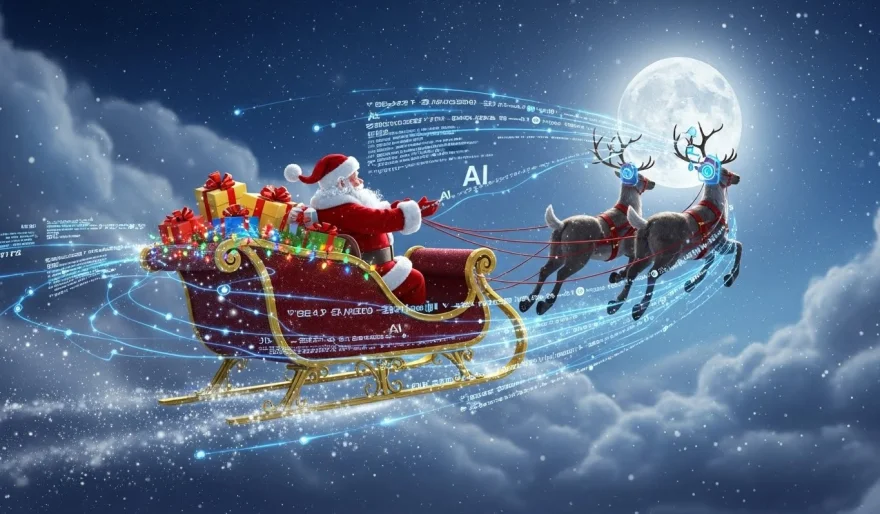
Every Christmas Eve, one question dominates households with kids: “Where’s Santa right now?”
The answer, once again, is AI-powered maps, assistants, and a surprising amount of compute for a man in a red suit.
What used to be a simple blinking dot on a map has quietly evolved into one of the most family-friendly demos of AI, mapping tech, and interactive storytelling on the internet.
Here’s how Santa tracking works in 2025 — and why it’s more interesting than it sounds.
NORAD’s Santa Tracker: now with generative AI magic
NORAD has been tracking Santa since 1955, making it one of the longest-running “tech traditions” on the internet. But this year, it’s less Cold War radar vibes and more AI-powered holiday playground.
The big update: NORAD has partnered with OpenAI to add generative AI features designed specifically for families and kids. That includes:
-
An image generator that turns selfies into animated elf characters
-
A toy idea generator that can turn prompts into printable coloring pages
-
A fill-in-the-blank storytelling tool that lets families insert names, places, and custom details into Christmas stories
It’s a subtle but clever use of generative AI: no hype, no productivity pitch — just creativity and play.
On the tracking side, NORAD has moved beyond flat maps. Santa’s journey is displayed in 3D, built on Cesium’s open-source mapping library and powered by Bing Maps satellite imagery. The result feels closer to a Google Earth experience than a cartoon animation.
There’s also the fan-favorite Santa Cam, which shows pre-recorded videos of Santa flying over different parts of the world — a small touch that keeps the illusion alive for kids while parents quietly appreciate the production value.
Zoom out, and NORAD’s site looks less like a tracker and more like a holiday hub: arcade-style games, music, videos, a digital library, and a countdown straight from the North Pole.
Google’s Santa Tracker: AI meets interactive learning
Google’s Santa Tracker, first launched in 2004, takes a slightly different approach — leaning into interactivity, learning, and assistant-driven experiences.
On Christmas Eve, the tracker shows:
-
Santa’s live location
-
His next destination
-
Estimated arrival times by region
-
Total distance traveled and gifts delivered
Throughout December, it doubles as Santa’s Village, packed with mini-games, animated shorts, and surprisingly good educational tools.
Kids can:
-
Build their own elf
-
Host concerts with “Elf Jamband”
-
Learn basic coding concepts through playful tutorials like Code Boogie
This is where Google quietly flexes its strength: turning entertainment into soft STEM education without calling it that.
And of course, Google Assistant is fully in on the act. Ask:
-
“Hey Google, where’s Santa?”
-
“What’s new at the North Pole?”
You’ll get narrated updates, a fictional North Pole newscast, and — yes — the option to call Santa directly.
It’s voice AI doing what it does best: making tech feel human, playful, and just believable enough.
Why this matters (even if it’s “just Santa”)
On the surface, this is holiday fun. Underneath, it’s something else entirely.
These Santa trackers are:
-
Safe, controlled demos of AI for families
-
Early exposure to generative tools without risk
-
A reminder that AI doesn’t always have to be about work, productivity, or disruption
For companies like Google and partners like OpenAI, this is brand trust-building at scale — introducing AI in a context where curiosity outweighs fear.
And for kids? Their first interaction with AI might not be a chatbot — but an elf, a story, or a flying sleigh on a 3D globe.
Not a bad way to learn that technology can still feel magical.









 AI Agents